
Tailored Integrated Impact Statement Guidelines have been released
The Guidelines are instructions to the NWMO on what information they must provide about their nuclear waste project, in their Impact Statement. It is important that their Impact Statement provide a detailed description of all parts of the project and the potential effects, as it will form the basis of the impact assessment process and public hearing.
The Impact Assessment Agency published the final Tailored Impact Statement Guidelines on July 3. The NWMO did not get their wish – that an examination of long-distance transportation of the used nuclear fuel waste be excluded from the assessment. The Guidelines, however, are weaker in other areas, and do not require a renewed examination of the alternatives to a DGR.
Despite these reasonable Impact Statement Guidelines, the Impact Assessment process is still uncertain, pending the federal government’s next moves concerning Projects of National Interest. Please see our July 13 media release.
FAQs about the Impact Assessment process
The Nuclear Waste Management Organization (NWMO) is planning to transport an estimated 140,000 tonnes of highly radioactive nuclear fuel waste to the Revell site in northwestern Ontario where it will be processed (repackaged) and placed in a deep geological repository. Transportation will take place over 50 years, with 2-3 trucks per day traveling an average of 1,800 km from the current location at nuclear generating stations. The wastes will be placed in a series of caverns and tunnels blasted out of rock approximately 800 metres below the surface. There is no long-term plan for monitoring the waste containers after they are placed in the underground chambers.
The Nuclear Waste Management Organization is a consortium of the provincial power companies who own and operate nuclear reactors to produce electricity. Ontario Power Generation is the largest and is responsible for more than 90% of the wastes, with smaller volumes generated and owned by Hydro Quebec and New Brunswick Power. The NWMO was formed in 2002 after the Nuclear Fuel Waste Act came into effect. The NWMO is the proponent of the Deep Geological Repository (DGR) for Canada’s Used Nuclear Fuel Project.
An impact assessment process is a multi-step review to evaluate the environmental, health, social, and economic impacts of major projects before they proceed. The process considers public and Indigenous input, scientific data, and traditional knowledge to determine if a project is in the public interest.
An impact assessment process is a multi-step process. During the first “planning” phase an initial description of the project which has been prepared by the proponent is reviewed and guidelines are developed that set out what information the proponent must include in their Impact Statement. During the next phase the proponent develops their Impact Statement, which is a detailed description of their project and proposed activities and how they might impact the environment or human health. During the third phase an impact assessment is carried out, based on the Impact Statement and including a public hearing. The fourth phase is the “decision phase” when the hearing panel reports to the federal government and the government decides on whether the project can go ahead, or under what conditions it can proceed.
Nuclear projects are licenced by the Canadian Nuclear Safety Commission, so an impact assessment and a review of the first of a series of CNSC license are carried out at the same time in an “integrated” or joint review.
The Impact Assessment Agency of Canada (IAAC) is an agency of the Government of Canada responsible for federal environmental assessment process of major projects and administering the Impact Assessment Act.
The Canadian Nuclear Safety Commission (CNSC) is the regulator for the use of nuclear energy and nuclear materials. They administer the Nuclear Safety and Control Act (NSCA), which governs the development, production, and use of nuclear energy and substances to protect health, safety, security, and the environment and numerous regulations under the NSCA, covering licensing, security, and transportation.
The federal impact assessment process began on January 5, 2026. It is a multi-year process, and a schedule has not been published, but the planning phase is expected to conclude by June 2026. In the next phase the NWMO will develop their Impact Statement. A public hearing is expected in 2028 or 2029 with a decision by the federal government in 2029 or 2030.
There are several licencing steps spread over several decades. The “Licence to Prepare the Site” will be issued in the same general time frame as the impact assessment decision. The Licence to Construct will be a few years later, and the Licence to Operate a few to several years after that. The license to close the site will not be applied for until operations are completed (the NWMO is describing this as a 160-year project). The Licence to Abandon the site is the last licence.
There are two 30-day comment periods during the “planning phase”. The first, commenting on the Initial Project Description, was between January 5 and February 4, 2026. The second is on the “draft Integrated Tailored Impact Statement Guidelines” (the guidelines) and commence on April 10 and will close on May 10. In future phases, the public will be invited to comment on the hearing panel’s terms of reference and to review the NWMO’s Impact Statement and then participate in a public hearing, including submitting reports, speaking to the panel, and posing questions.
FAQs about the Integrated Tailored Impact Statement Guidelines
In an Impact Assessment the guidelines outline the information requirements that must be provided in an Impact Statement.
The “Integrated Tailored Impact Statement Guidelines” (the “guidelines”) outline the required studies, scope, and information that the proponent – in this case the NWMO – must provide so the project’s potential environmental, health, social, and economic impacts can be assessed. They also direct the proponent to describe how they have evaluated cumulative effects, considered Indigenous knowledge, and incorporated mitigation measures.
An Impact Statement is the information provided by the proponent in order for the Review Panel to assess the potential effects of the project. It is the information base provided by the proponent for the public review and the public hearing.
The guidelines are important because they will determine what information the proponent must present in the Impact Statement and supporting documents, which will then form the basis of the assessment process, including the public hearing.
Quick Links
KEY FACTS
A federal review of the Nuclear Waste Management Organization’s (NWMO) “Adaptive Phased Management Project” is underway.
The NWMO’s plan is to transport, process and bury all of Canada’s nuclear fuel waste at a site between Ignace and Dryden in northwestern Ontario. The project will include 50 years of transporting highly radioactive waste with average transportation distances of 1,800 km per trip (1,700 from Ontario reactors). The 160 years of operation will place 150,000 tonnes of the radioactive waste underground in the headwaters of the Wabigoon River watersheds.
NWMO has selected a site between Ignace and Dryden in northwestern Ontario, in the heart of Treaty 3 territory. The NWMO has deemed only Wabigoon Lake Ojibway Nation and the Township of Ignace to be “host communities”.The Township of Ignace is 45 km east of the site and in a different watershed; there are other communities closer by and hundreds of communities along the transportation route and downstream from the site who the NWMO has not included in their decision to select the Revell site.
The NWMO describes the Revell site as being “in the territory of Wabigoon Lake Ojibway Nation” but there are several other Treaty 3 Nations who are also in relationship with the land NWMO has selected. Treaty 3 Chiefs in Assembly have expressed their opposition, as have Nishnawbi Aski Nation, Anishnabek Nation and Chiefs of Ontario.
The NWMO project will generate radioactive releases at each stage, from transportation to when the wastes are eventually abandoned underground.
There is no operating deep geological repository (DGR) for high-level nuclear waste anywhere in the world; there are projects in Finland and Sweden under development, but no DGR has received final approval or begun to operate.
We the Nuclear Free North will continue sharing news, analysis and updates. Check here again soon, or email nuclearfreenorth@gmail.com to be added to our e-news list and receive regular updates.
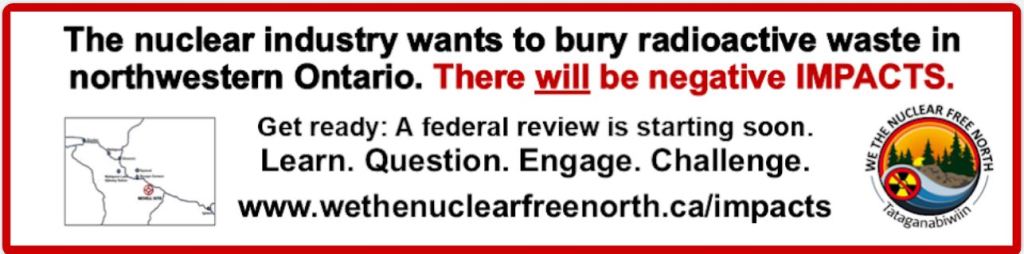
A “one minute action” you can take today:
1. If you haven’t yet, send an email to the Impact Assessment Agency asking to be added to their email list for notices regarding their review of NWMO’s nuclear waste project. Once on the list, you will receive email communications regarding all upcoming stages and comment periods. Make your email brief, simply asking to be added to the list. The email address is nuclearwaste-dechetsnucleaires@iaac-aeic.gc.ca . Note that commenting during comment periods does not automatically add you to the list.
And then, if you have a few more minutes – write a letter or four!
- Email Prime Minister Carney at pm@pm.gc.ca
- Email the Honourable Julie Dabrusin, Minister of the Environment and Climate Change at ministre-minister@ec.gc.ca and/or julie.dabrusin@parl.gc.ca
- Email the Honourable Tim Hodgson, Minister of Energy and Natural Resources at NRCan.Minister-Ministre.RNCan@canada.ca and/or tim.hodgson@parl.gc.ca
- Email your Member of Parliament. You can find their email address at https://www.ourcommons.ca/members/en
We the Nuclear Free North continues to support informed public discussion and criticism of the NWMO’s plan to transport, process, bury and abandon all of Canada’s nuclear fuel waste at the Revell site in the heart of Treaty 3 territory in northwestern Ontario.
For updates in your Inbox:
If you have not already, sign-up for our contact list to receive news and analysis throughout the review process (including this “trial balloon” being rolled out by NWMO).

